about
about
Building
Bamboo
Our interest lies in finding potential and opportunities in construction with small-diameter bamboo that are abundant and cheap but are usually neglected in construction practices due to their limited structural capacity, because of their small diameter.
Advisor: Toshiko Mori
Group: Htet Hliang
2025 Fall

There are more than 1,700 bamboo species that exist in the world, yet only 90 species have documented records for being used in construction. The best bamboo with a larger diameter belongs to the Guadua, Dendrocalmus, and Bambusa genera, often growing up to 15-30cm in diameter.
Our interest lies in finding potential and opportunities inconstruction with small-diameter bamboo that are abundant andcheap but are usually neglected in construction practices due toits limited structural capacity because of its small diameter.

What is a small-diameter bamboo?
There is no exact definition for small-diameter bamboo. We are categorizing small-
diameter bamboo as bamboo that has a diameter less than 6 inches (15cm).
Their current use includes scaffolding, roof purlins, and infill for wattle-and-daub
construction, as garden stakes, and as non-structural woven mats and spits for baskets and furniture.
Why study small-diameter bamboo?
-
Abundant and affordable
-
Fast growing / shorter wait time
-
Lightweight
-
Inherently Flexible
-
Easier to assemble and transport
Bamboo Tectonics

bamboo assembly typologies study
Binding Techniques

round lashing

shear lashing

square lashing

diagonal lashing
Our goal is to explore small diameter bamboo as an alternative to large diameter bamboo. In conventional construction, bamboo viewed as linear with materials as infill. Small diameter bamboo, however, offers greater flexibility in shaping structures. It can be seen as a modular unit, like bricks, or as a surface similar to CLT. To maintain load capacity columns may need thicker bundles and can be staggered or splayed.
In standard bamboo construction, bamboo is harvested between 3 to 6 years and is processed by skilled labor, enabling the use of fewer and more precise members during construction. In small diameter bamboo construction, certain species can mature in as little as 4 months, while others are ready for harvest in2-3 years. This allows for easier community participation, as the sizes and bundles are small, and the construction process can involve less skilled workers along with more unskilled laborers.

We are focused on using small-diameter with simple, low-tech assembly methods. This led us to explore modular designs that leverage the smaller size and higher density of these bamboo. We categorize them into three groups: point, line, plane, employing various techniques to join them together.

9 types of modular unit

This diagram shows how the modules assemble into a system for an 8x8 ft room. We measured material usage digitally and assessed the difficulty level for effective creation.
We are ongoing in our exploration of modular unit design. By leveraging our in binding techniques, we have created a collection of modular bamboo units.


We keep track of the time and materials used. In some scenarios, such as bundling bamboo, the process is quick (4, 5, and 6), but it requires more materials. By documenting these details, we aim to create a toolkit that helps users understand the various options available.


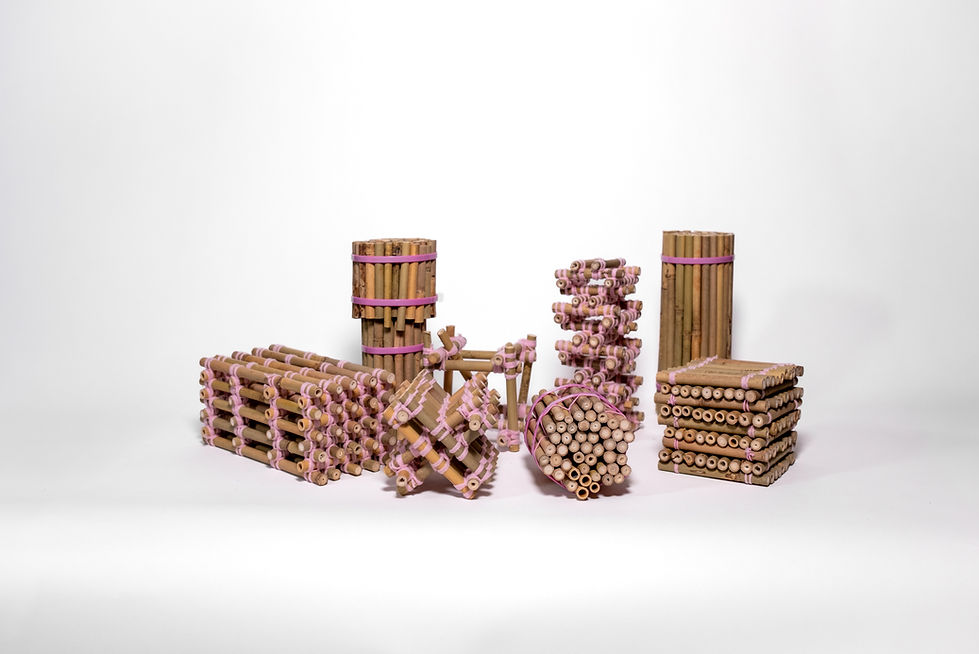

The bamboo design readapted into a installation for Harvard GSD Student Event Beer and Dog.
Credit: South East Asia GSD